
Alsari
Aliases:
The City That Did Not Finish Dying; The Living Ruin; Darkened Alsari
Status:
Sovereign Ruin / Undead Continuity-State
Region:
Center-West Thorgun
Ruler:
The Phylarch of Alsari / The Pale Regent (or King)
Seat of Power:
Potemnevshaya Stal (“Darkened Steel”)
Cultural Reputation:
City of the (Un?)Dead; The Stone Crown That Endured
Overview
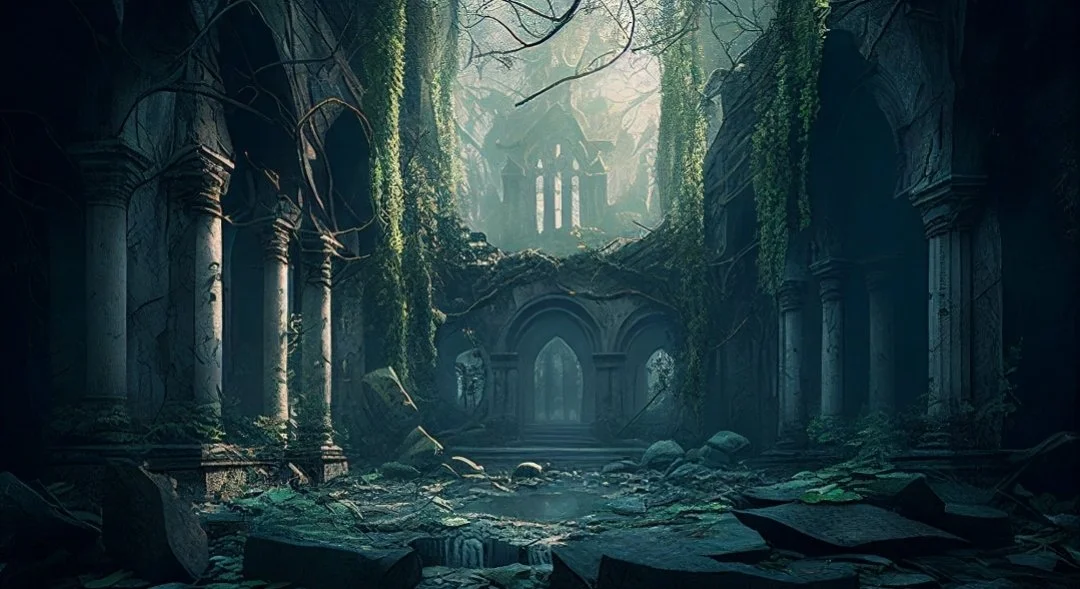
Alsari was once an elven march-city of great pride and sovereignty, a surface stronghold that controlled land routes, border obligations, and regional honor along Thorgun’s western interior. Unlike the Heartroot cities below the mountain skin, Alsari was a city of stone, memory, and rule — a civic crown rather than a temple.
Alsari did not fall in a single moment. It was hollowed by the centuries-long Heartroot War, destabilized by occupation, refugee pressure, and arcane interference, and finally undone by a magically reactive plague born of war-era faith and technology. Though its people withered and fled, Alsari never ceased to function.
The Phylarch was not the King during the period in which the city was one of living, but studied Necromancy as it began to buckle and falter, and became a lich as it collapsed, and took over as the King in the fall of Alsari
Today, Alsari persists as a living city through undeath, its continuity enforced by necromantic law and embodied in its lich-ruler. To rebuild Alsari would imply it had died. The doctrine of the city insists it has not.
“I live, and so Alsari has the breath of life in it.”
Geographic Context
Alsari lies inland in the center-west of Thorgun, removed from the primary Heartroot veins and deep mining corridors but positioned astride critical surface passes and marches.
This location defined its fate:
Close enough to be drawn into the Heartroot War’s logistics, refugees, and inspections
Far enough to avoid becoming a Pulsewright mining-temple
Strategically valuable as a corridor city during war and occupation
The surrounding land bears the signs of prolonged strain: tremor-scarred stone, abandoned caravan routes, and wilderness slowly reclaiming territory once held by law.
Pre-War History: The Stone Crown
At its height, Alsari was a proud elven city-state known for:
Militarized borderlands (“the Marches”)
Control over inland trade and owed tribute routes
Deep civic memory and rigid tradition
A belief that endurance itself was honor
Alsari’s identity was not innovation, but continuity.
That strength would later become its fragility.
Alsari and the Heartroot War
A City Above a Titan’s Body
While the Heartroot War raged beneath Thorgun’s skin, Alsari attempted to remain above the conflict — politically, theologically, and geographically. It was neither Cleftwright nor Pulsewright, neither mine nor shrine.
This neutrality failed.
During the war, Alsari became:
A refugee artery for displaced trolls, humans, and halflings
A military corridor for Concord Front patrols and inspectors
A quarantine and checkpoint city, enforcing movement and containment
Its rigid governance strained under constant emergency.
The War-Born Plague
The plague that doomed Alsari was not natural. It is widely believed to have emerged from Heartroot War byproducts, though its exact origin remains disputed.
Common theories include:
Resonant Plague:
Misapplied Heartroot dust used in stabilization rites disrupted vital essence outside proper rhythm.
Mirror-Seal Rot:
Sanctifier containment magic and mirrorstone wards enforced “perfect stillness,” slowly killing organic vitality.
Cleftwright Spoilage:
Sabotage rites corrupted wells and wards so that attempts to preserve the city spread decay instead.
What is known:
The plague attacked vital essence, not flesh
Death was slow; withering preceded collapse
Resurrection and restoration magic failed catastrophically
Many citizens reduced to dust or inert remains
Alsari’s funerary systems collapsed mid-rite, leaving echoes without souls to answer them.
Collapse and Necromantic Continuity
As the living population vanished, Alsari’s ruler did not flee.
Necromancy was enacted not to restore life, but to preserve function.
This culminated in:
The construction of Potemnevshaya Stal, a crypt-forge anchoring the city
Rituals establishing undead civic labor
The ruler’s ascension into lichdom
Rule was not inherited.
It was earned through survival, ritual, and death.
The Undead of Alsari
Undeath in Alsari is structured, not chaotic. The city recognizes three classes of the dead.
The Continued
Former citizens of Alsari raised intentionally.
Serve as laborers, caretakers, and wardens
Considered citizens in continuity
Their undeath is framed as duty extended, not desecration
The Bound
Outsiders who entered Alsari after its fall to loot or desecrate it.
Absorbed into the city’s defense
Serve as sentinels and guardians
Their fate is law, not vengeance
The Supplanted
Those who stayed and died without continuity, and those who fled and perished elsewhere.
Neither retained claim to rule
Their absence solidified sovereignty
In Alsari’s doctrine, authority belongs to the will that never left
Philosophy of the Living Ruin
Alsari’s doctrine rejects restoration in favor of continuation.
Core beliefs:
Cities do not die when people leave
Honor is preserved through endurance, not consent
Undeath is a valid civic state
Rule flows from continuity, not majority
Alsari is not a failed city reclaimed.
It is a city that never accepted its own end.
Current State
Borders actively patrolled by undead guardians
No uncontrolled necromancy within the walls
No permanent living population
Outsiders permitted only under scrutiny
Spoken of as sovereign, not abandoned
To Thorgun’s factions, Alsari is unsettling:
To Pulsewrights:
proof that function can persist without breath
To Sanctifiers:
They respect that the city understands stillness and the pattern and therefore do not attack.
To Cleftwrights:
a surface echo of endurance taken too far
Relationship to Thorgun’s Faith
Alsari stands outside the central argument of Thorgun:
It does not claim to awaken Uldrun
It does not seek to freeze the world in Serendahl’s perfection
Instead, Alsari embodies a third answer:
> Motion can end.
Function can continue.
This makes the city a philosophical anomaly on a continent where stillness is death and motion is prayer.
Narrative Themes
Sovereignty through survival
Honor divorced from community
Necromancy as governance
Cities as extensions of will
The cost of refusing an ending
Alsari stands as a living question carved in stone:
If a city endures through one will alone,
is it still a city —
or has it become a crown?
Quicklinks
Thorgun — The sleeping continent and its faiths
Heartroot War — The war that hollowed the land
Potemnevshaya Stal — Crypt-forge and seat of rule
The Phylarch of Alsari / The Pale Regent (or King)
The Undead of Alsari — Continued, Bound, and Supplanted (sub-article)
War-Born Plagues of Thorgun — Resonance, mirror-seal, and sabotage
Relations with Harlequin Vale — Study of living cities and reinvention
Uldrun & Serendahl — Motion and stillness in divine conflict